Why Assessment Produces Data but Little Institutional Learning
From reporting activity to evidence-informed decisions.
Assessment becomes meaningful when institutions learn how to interpret evidence, support faculty, improve decision making, and demonstrate mission fulfillment.
From reporting activity to evidence-informed decisions.
Moving Toward Evidence-Informed Decision Making
Questions that strengthen interpretation and follow-through.
The Alignify Method™ is strengthened through ongoing research, institutional implementation, faculty partnership, observation, validation, and continuous refinement. Each cycle expands the methodology while reinforcing its ability to produce meaningful evidence and institutional capability.
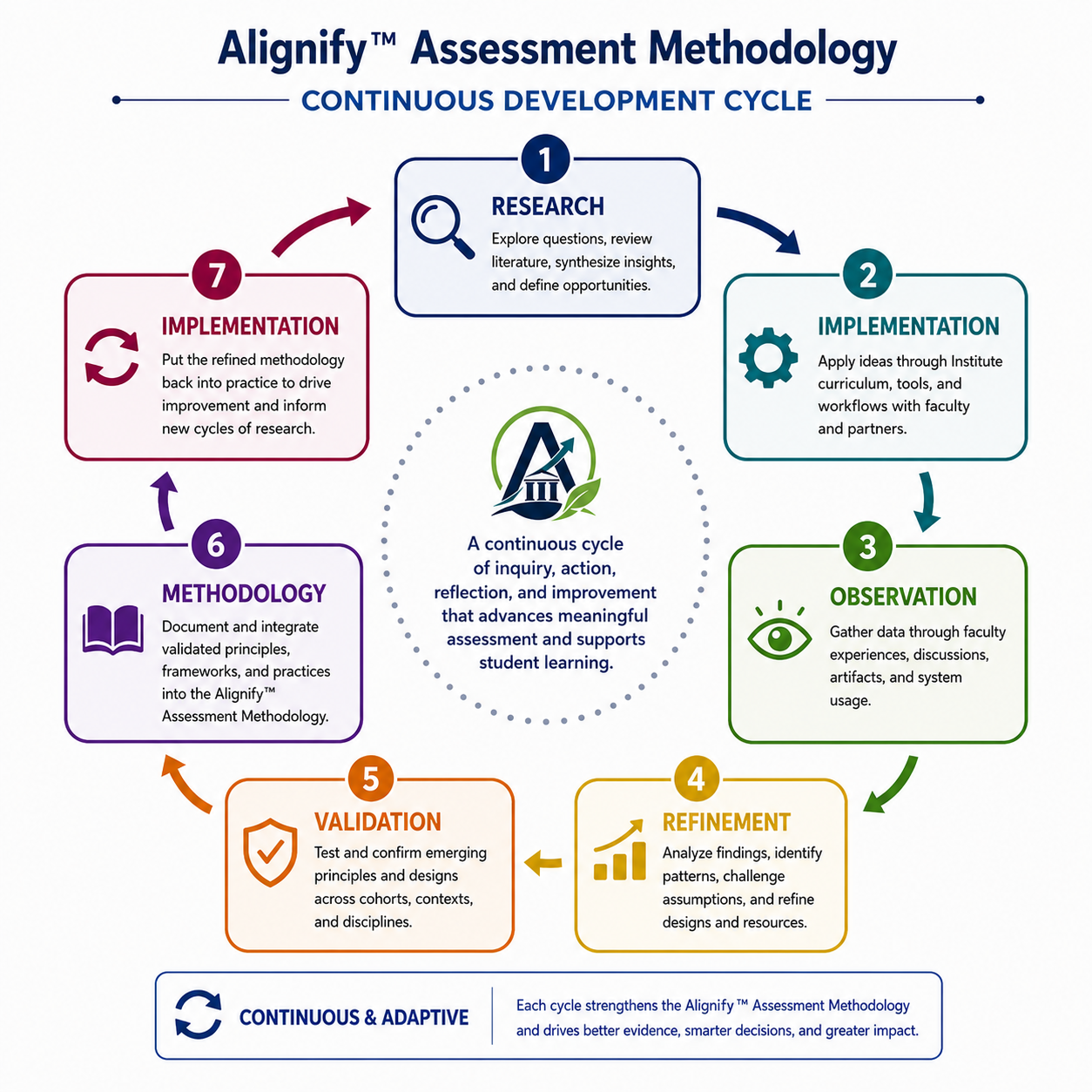
Current research, institutional experience, and emerging practices identify new opportunities to strengthen the methodology.
Partner institutions, faculty, and leaders apply the methodology across diverse academic environments, generating practical insights for continuous refinement.
Evidence from implementation informs validation, strengthens methodology components, and improves supporting resources and tools.
Validated improvements become part of the Alignify Method™, professional learning experiences, platform capabilities, and future research initiatives.
Explore perspectives developed through institutional leadership, assessment practice, faculty development, and the design of the Alignify methodology.
The story of how a software project became curriculum, a Faculty Assessment Institute, and a coherent methodology for meaningful assessment.
Read the storyA practical examination of the path from extensive assessment activity to institutional learning and coordinated action.
View availabilityExplore the complete twelve-step framework from course design through continuous improvement.
Explore the methodologyEach topic connects practical guidance with the broader systems, decisions, and people required to sustain improvement.
Design, collection, interpretation, and evidence quality.
→ 02Meaningful participation grounded in authentic faculty work.
→ 03Evidence systems that support confidence, continuity, and review.
→ 04Connected processes that turn evidence into institutional learning.
→ 05Evidence-informed priorities, progress, and resource decisions.
→ 06Demonstrating institutional purpose through meaningful evidence.
→Alignify publications are organized by purpose and access level. Public resources build shared understanding. Professional guides support deeper application. Client and platform resources preserve the tools that create sustained implementation value.
Thought leadership, conference materials, infographics, decision guides, and concise resources available to read or download.
02PROFESSIONAL GUIDESSubstantial guides that help faculty and academic leaders strengthen assessment design, evidence use, and improvement.
03CLIENT TOOLKITSWorkbooks, templates, review tools, governance resources, and facilitated materials provided through institutional partnerships.
04PLATFORM RESOURCESInteractive workflows, dashboards, templates, reporting capabilities, and integrated guidance delivered inside Alignify.
Assessment is a means to institutional learning and improvement.
Evidence becomes valuable through interpretation, context, and use.
Faculty engagement begins with meaningful design and authentic work.
Institutional capability grows through shared methodology and coordinated practice.
Continuous improvement requires visible decisions, responsibility, and follow-through.
Mission fulfillment is demonstrated through meaningful evidence.
This presentation examines the persistent gap between institutional assessment activity and institutional learning, then introduces a practical path from collected data to meaningful evidence and coordinated action.
Explore available free resources and discover professional, client, and platform materials. Additional publications will be released as they become available.
Three starting points for understanding the Alignify Assessment Methodology and turning evidence into institutional learning.
Explore the twelve-step progression from intentional course learning objectives to evidence-informed continuous improvement.
Download Visual →Learn why AAM distinguishes the ability to generate defensible evidence of intended learning from the ability to measure that evidence.
Read the Explanation →A concise perspective on connecting evidence, interpretation, understanding, action, and institutional learning to mission fulfillment.
Download Executive Brief →Practical Alignify publications for faculty, assessment leaders, and institutional teams seeking consistent, meaningful assessment practices. Contact Alignify for purchasing and institutional licensing information.
A comprehensive guide to choosing, planning, documenting, and reviewing evidence collection methods.
Inquire About This Guide →Guidance for preparing rubric criteria that generate structured evidence and align clearly with course learning objectives.
Inquire About This Guide →A practical path from results to interpretation, shared understanding, and evidence-informed action.
Inquire About This Guide →Guidance for connecting findings, decisions, ownership, follow-through, and future assessment cycles.
Inquire About This Guide →Ideas and experiences that advance the conversation about meaningful evidence and institutional capability.
The story of how software design, curriculum development, and faculty collaboration became a coherent assessment methodology.
Read the Story →Moving toward evidence-informed decision making through shared expectations and coordinated practice.
Request Presentation Information →Explore the twelve-step methodology from course learning objectives through continuous improvement.
Explore the Methodology →Implementation tools remain connected to facilitated institutional work and the operational environment that gives them value.
Structured prompts for examining evidence quality, context, interpretation, decisions, and follow-through.
Discuss Institutional Access →Applied worksheets, planning tools, templates, and references that support consistent faculty practice.
Explore the Institute →Interactive templates, structured data collection, review workflows, evidence management, and continuous improvement tools.
Explore the Platform →Alignify resources can begin the conversation. Our institutional partnerships help transform those ideas into shared methodology, practical capability, and sustainable improvement.
Start the Conversation