THE ALIGNIFY™ ASSESSMENT METHODOLOGY
Building institutional capability through meaningful evidence.
WHY A SHARED METHODOLOGY MATTERS
Every institution has evidence. Few have a shared methodology.
The challenge is keeping evidence connected from authentic faculty work to institutional decisions. The Alignify Assessment Methodology™ preserves that continuity through intentional design, consistent measurement, interpretation, communication, and action.
Faculty, reviewers, academic leaders, and executives gain a common foundation while disciplinary expertise and institutional context remain visible.
THE FOUR INSTITUTIONAL CAPABILITIES
What the methodology builds.
Meaningful evidence, shared methodology, executive insight, and continuous improvement work as one connected system. Each capability strengthens the next.
THE FIRST CAPABILITY
Meaningful Evidence
Connect Learning to Mission.
Meaningful evidence begins with student learning, but its value extends across the institution. When evidence is intentionally connected from courses to programs, institutional priorities, and mission fulfillment, assessment becomes a source of institutional understanding.
Evidence Begins With
Student Learning
Faculty gather evidence of what students know, understand, and can demonstrate through intentional learning activities.
Evidence Connects To
Program Outcomes
Course-level evidence contributes to a broader understanding of student achievement across the curriculum.
Evidence Informs
Institutional Priorities
Connected evidence helps leaders understand progress toward strategic, academic, and student-success priorities.
Evidence Demonstrates
Mission Fulfillment
Institutions can demonstrate how learning, programs, and priorities collectively advance their mission.
Purposeful
Evidence is collected to answer meaningful questions, not simply to satisfy reporting requirements.
Connected
Evidence remains visible across courses, programs, institutional priorities, and mission.
Interpretable
Evidence is structured so faculty and leaders can understand what the results reveal.
Actionable
Evidence supports informed decisions, focused improvement, and institutional advancement.
Evidence becomes meaningful when its purpose is visible.
Every result connects learning to institutional mission.
Shared Methodology
creates a common language.
Executive Insight
creates a shared understanding.
THE THIRD CAPABILITY
Executive Insight
See the Institution as
One Connected System.
Executive insight transforms meaningful evidence into institutional understanding. By connecting learning outcomes, program performance, institutional priorities, and mission fulfillment, leaders gain the clarity needed to make informed decisions with confidence.
Explore the PlatformExecutive Briefing
Institutional Performance Summary
Spring 2026
Institutional Snapshot
Mission Performance
92%
On Track
▲ +4% vs. prior cycle
Strategic Alignment
4 of 5
On Track
Objectives performing above target
Academic Health
Faculty Participation
98%
Assessment Completion
100%
Improvement Plans
95%
Follow-Up Resolution
95%
Institutional Focus
- Engineering
- Business
- Student Success
- Global Engagement
- Operational Excellence
All metrics reflect institution-wide performance across programs and courses.
Connected Visibility
Bring evidence together across courses, programs, institutional priorities, and mission fulfillment to create one institutional view.
Strategic Confidence
Understand strengths, risks, and opportunities before they become accreditation findings or operational challenges.
Executive Decisions
Transform evidence into confident institutional decisions supported by meaningful, connected insight.
Evidence becomes understanding.
Understanding strengthens leadership.
Leadership advances the institution.
THE FOURTH CAPABILITY
Continuous Improvement
Build Capability Across Every Cycle.
Sustainable improvement requires more than identifying opportunities. Institutions must interpret evidence, make informed decisions, implement meaningful actions, and follow those actions through to measurable institutional advancement.
Evidence
Generate reliable evidence about learning, performance, and institutional priorities.
Interpretation
Understand what the evidence reveals about strengths, gaps, and emerging institutional needs.
Action
Translate institutional understanding into focused, realistic, and accountable improvement decisions.
Follow-Through
Monitor implementation, document progress, and determine whether improvement actions produced the intended result.
Institutional Advancement
Use each completed cycle to strengthen institutional capability, decision-making, and mission fulfillment.
Focused Priorities
Improvement efforts remain connected to the evidence and centered on the areas with the greatest institutional significance.
Clear Accountability
Every action has identified ownership, expected outcomes, and a defined timeline for follow-through.
Visible Progress
Leaders can understand what has been implemented, what remains in progress, and where additional attention is required.
Institutional Learning
Each improvement cycle contributes to shared knowledge, stronger practices, and greater organizational confidence.
Institutional transformation occurs through deliberate, sustained improvement.
Every improvement cycle builds institutional capability.
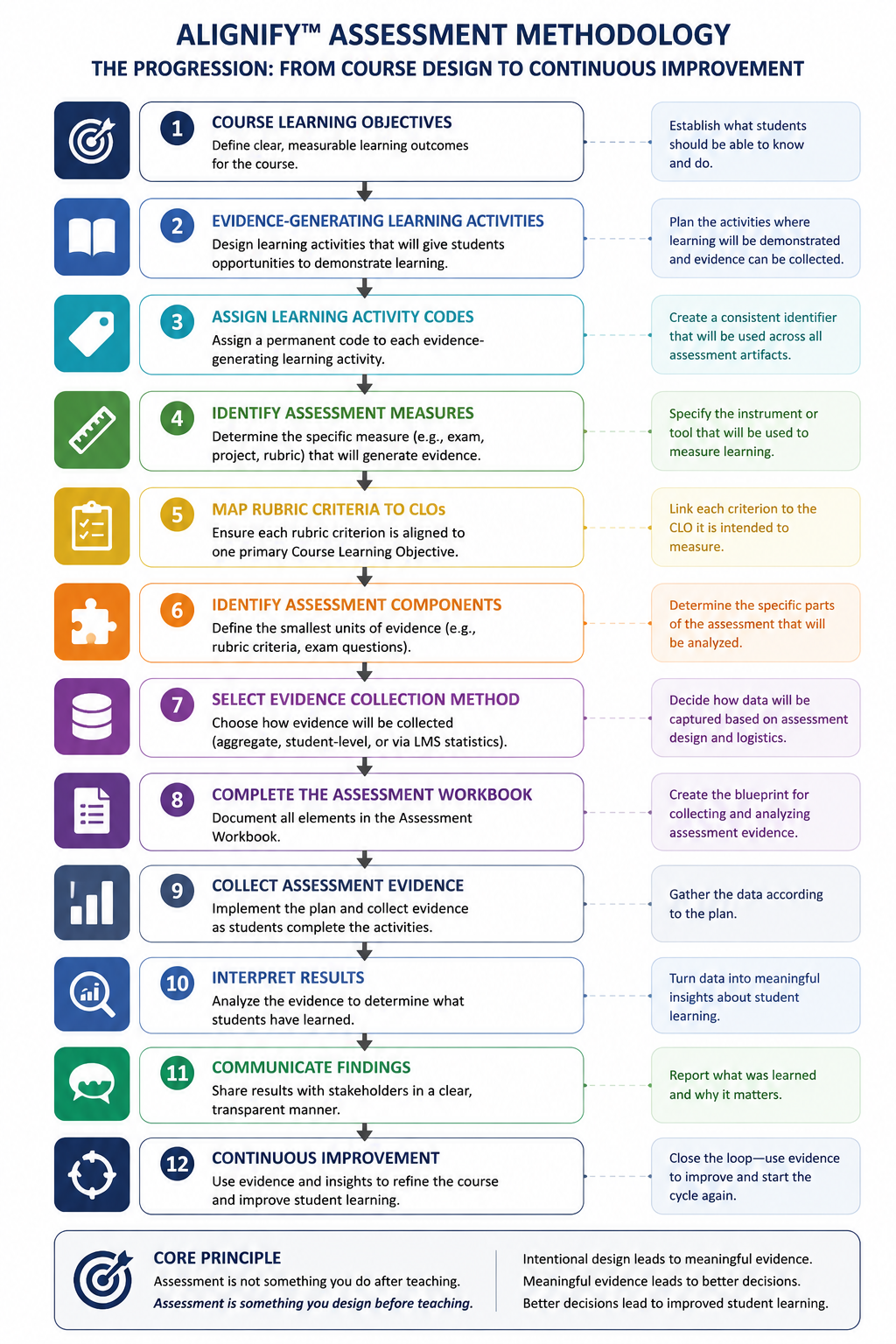
A shared framework for meaningful assessment.
Each step builds on the one before it, creating a clear progression from course design to evidence-informed improvement.
Designed
Intentional before instruction begins.
Measured
Evidence is collected consistently.
Improved
Evidence drives institutional learning.
One progression from intentional design to continuous improvement.
Open each step for a concise explanation of its purpose and its place within the complete methodology.
01Course Learning Objectives+
Define clear, measurable learning outcomes for the course. These objectives establish what students should be able to know and do.
02Evidence-Generating Learning Activities+
Design learning activities that allow students to demonstrate the intended learning outcomes and generate usable evidence.
03Assign Learning Activity Codes+
Assign a permanent code to each evidence-generating learning activity so it can be identified consistently across terms and records.
04Identify Assessment Measures+
Determine the instrument used to measure learning, including its scale, method, or rubric.
05Map Rubric Criteria to CLOs+
Link each rubric criterion to one primary Course Learning Objective so every criterion contributes to a defined outcome measure.
06Identify Assessment Components+
Define the specific parts of the assessment that will be analyzed, including the smallest units of evidence.
07Select Evidence Collection Method+
Choose how evidence will be collected, including aggregate data, student-level data, or LMS-based statistics.
08Complete the Assessment Workbook+
Document the assessment blueprint, coding structure, and analysis framework before evidence collection begins.
09Collect Assessment Evidence+
Implement the plan and collect evidence as students complete the identified learning activities.
10Interpret Results+
Analyze the evidence to determine what students learned, identify patterns, and understand areas of strength and opportunity.
11Communicate Findings+
Share results with stakeholders through a clear, transparent narrative that explains what was learned and why it matters.
12Continuous Improvement+
Use the evidence and interpretation to improve the course, strengthen student learning, and begin the next assessment cycle.
The methodology comes first.
Each part of Alignify carries the shared framework forward—from institutional practice to sustained transformation.
The methodology defines the work. The platform preserves the connection.
Alignify operationalizes the method through workflows that keep evidence, interpretation, review, and institutional action connected.
A GROWING BODY OF KNOWLEDGE
Methodology resources for institutional use.
The resource collection will expand as Alignify publishes additional faculty, coordinator, executive, and implementation guidance.
AVAILABLEAssessment Methodology OverviewView the complete twelve-step framework
IN DEVELOPMENTFaculty Quick Reference GuideA practical companion for course-level implementation
IN DEVELOPMENTProgram Coordinator WorkflowGuidance for review, governance, and follow-up
IN DEVELOPMENTExecutive OverviewA leadership brief connecting evidence to institutional action
BUILD INSTITUTIONAL CAPABILITY THROUGH A SHARED METHODOLOGY
Connect meaningful evidence to meaningful action.
Whether your institution is strengthening assessment, preparing for accreditation, or building a culture of continuous improvement, the Alignify Assessment Methodology™ provides a practical framework for moving forward.
Start the Conversation