Fragmented Evidence
Assessment evidence becomes most valuable when it is connected across courses, programs, and institutional processes to provide a comprehensive view of student learning.
Build the institutional capability to generate meaningful evidence, strengthen executive decision-making, and transform assessment into continuous improvement and mission fulfillment.
Methodology. Platform. Faculty Development. Institutional Partnership.
Collecting assessment data is an important first step. Institutional success depends on transforming that data into shared understanding, executive insight, and continuous improvement.
Assessment evidence becomes most valuable when it is connected across courses, programs, and institutional processes to provide a comprehensive view of student learning.
Reporting deadlines become the destination rather than a step toward interpretation, improvement, and institutional learning.
Learning evidence has the greatest impact when it connects to institutional priorities, strategic decisions, and mission fulfillment.
Assessment data is only the beginning.
Institutional value is realized when that evidence informs decisions, guides strategy, and advances mission fulfillment.
Institutional capability transforms assessment into sustainable improvement by connecting meaningful evidence, shared methodology, executive insight, and continuous improvement into a unified organizational discipline.
Evidence that informs decisions.
Consistent practices across the institution.
Visibility that supports informed leadership.
Evidence translated into action.
Institutional capability is an organizational discipline
Traditional assessment often centers on collecting evidence and producing reports. The Alignify Method™ builds institutional capability by connecting meaningful evidence to learning, leadership, strategic planning, and mission fulfillment through one shared framework.
Create connected institutional processes that support continuous improvement and strengthen long-term performance.
Keep evidence aligned to institutional priorities through shared methodology, consistent workflows, and purposeful interpretation.
Give institutional leaders clearer visibility into learning, progress, strategic priorities, and sustainable impact.
THE FIRST CAPABILITY
Meaningful evidence begins with student learning, but its value extends across the institution. When evidence is intentionally connected from courses to programs, institutional priorities, and mission fulfillment, assessment becomes a source of institutional understanding.
Faculty gather evidence of what students know, understand, and can demonstrate through intentional learning activities.
Course-level evidence contributes to a broader understanding of student achievement across the curriculum.
Connected evidence helps leaders understand progress toward strategic, academic, and student-success priorities.
Institutions can demonstrate how learning, programs, and priorities collectively advance their mission.
Evidence is collected to answer meaningful questions, not simply to satisfy reporting requirements.
Evidence remains visible across courses, programs, institutional priorities, and mission.
Evidence is structured so faculty and leaders can understand what the results reveal.
Evidence supports informed decisions, focused improvement, and institutional advancement.
Evidence becomes meaningful when its purpose is visible.
creates a common language.
creates a shared understanding.
Executive insight transforms meaningful evidence into institutional understanding. By connecting learning outcomes, program performance, institutional priorities, and mission fulfillment, leaders gain the clarity needed to make informed decisions with confidence.
Learn MoreInstitutional Performance Summary
Mission Performance
On Track
▲ +4% vs. prior cycle
Strategic Alignment
On Track
Objectives performing above target
Academic Health
Institutional Focus
All metrics reflect institution-wide performance across programs and courses.
Bring evidence together across courses, programs, institutional priorities, and mission fulfillment to create one institutional view.
Understand strengths, risks, and opportunities before they become accreditation findings or operational challenges.
Transform evidence into confident institutional decisions supported by meaningful, connected insight.
Evidence becomes understanding.
Understanding strengthens leadership.
Leadership advances the institution.
THE FOURTH CAPABILITY
Sustainable improvement requires more than identifying opportunities. Institutions must interpret evidence, make informed decisions, implement meaningful actions, and follow those actions through to measurable institutional advancement.
Generate reliable evidence about learning, performance, and institutional priorities.
Understand what the evidence reveals about strengths, gaps, and emerging institutional needs.
Translate institutional understanding into focused, realistic, and accountable improvement decisions.
Monitor implementation, document progress, and determine whether improvement actions produced the intended result.
Use each completed cycle to strengthen institutional capability, decision-making, and mission fulfillment.
Improvement efforts remain connected to the evidence and centered on the areas with the greatest institutional significance.
Every action has identified ownership, expected outcomes, and a defined timeline for follow-through.
Leaders can understand what has been implemented, what remains in progress, and where additional attention is required.
Each improvement cycle contributes to shared knowledge, stronger practices, and greater organizational confidence.
Institutional transformation occurs through deliberate, sustained improvement.
THE INSTITUTIONAL OPERATING SYSTEM
Alignify connects assessment, governance, evidence, and institutional decision-making within one coordinated environment. Faculty, academic leaders, and executives work from a shared structure while maintaining clear responsibilities across the institutional lifecycle.
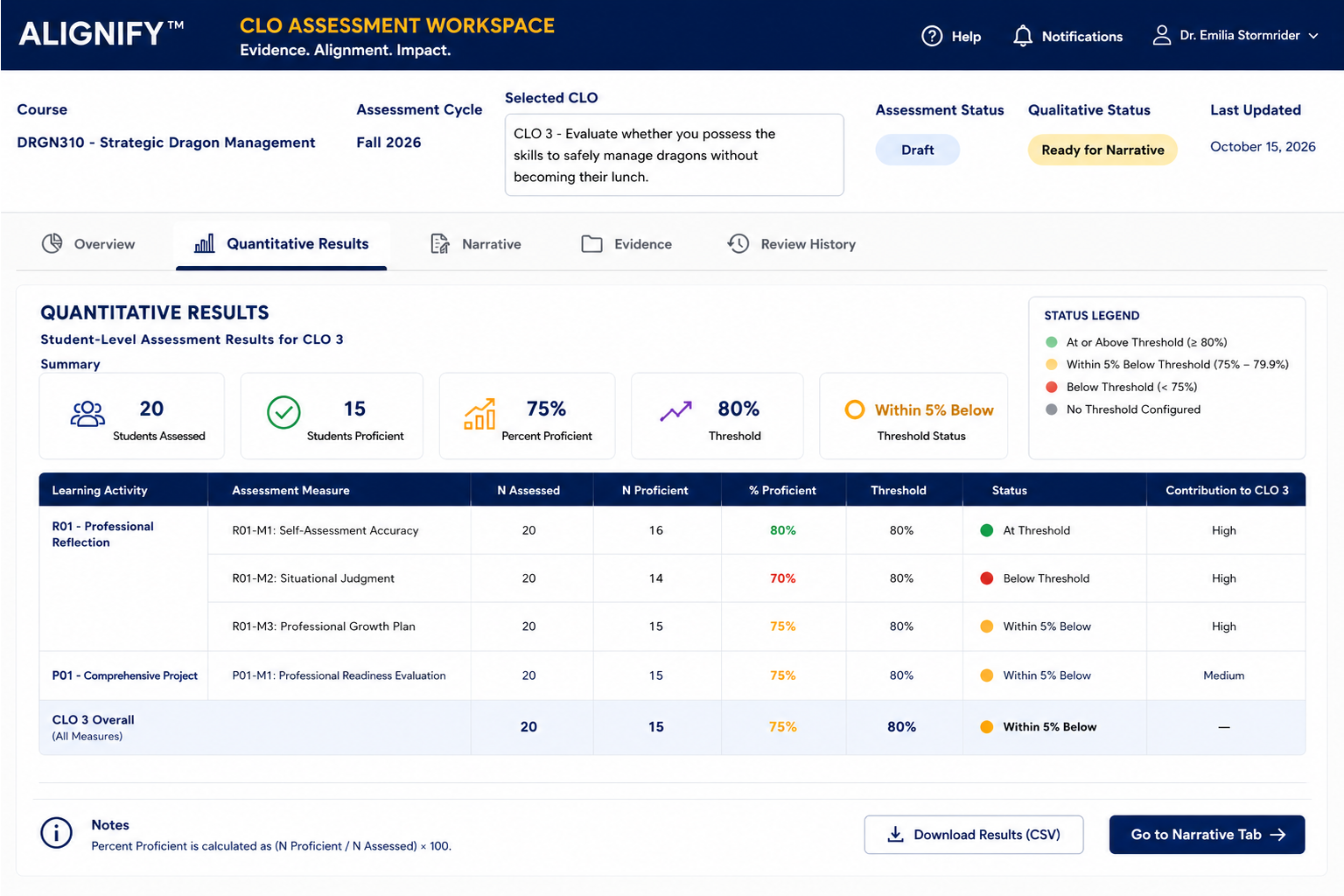
Capture meaningful evidence through a structured faculty workflow that keeps assessment activity visible from draft through approval.
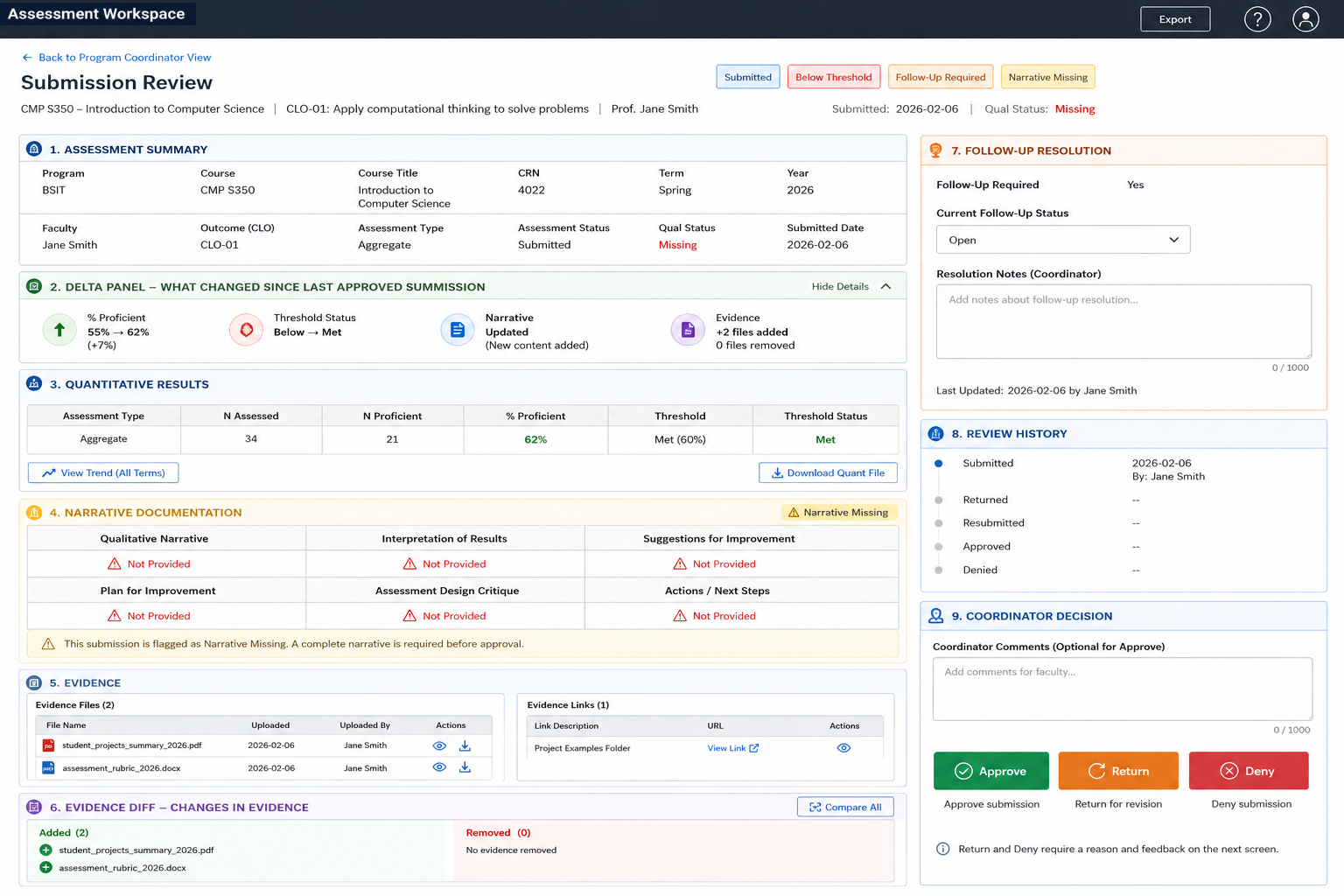
Give program coordinators a complete view of assessment quality, evidence, narrative completeness, threshold status, and required follow-up.
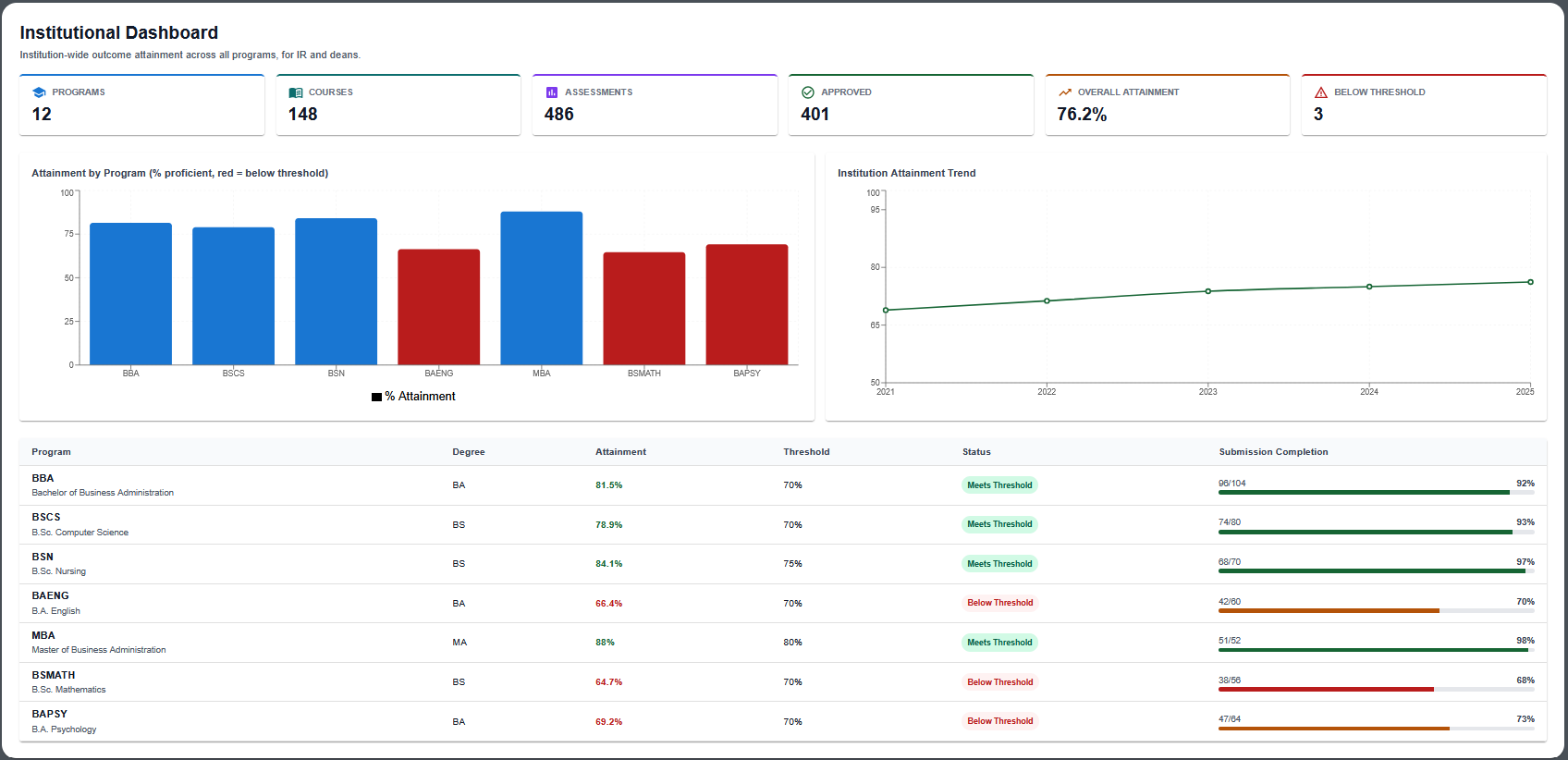
Translate assessment activity into institution-wide visibility so leaders can identify strengths, risks, and priorities across programs.
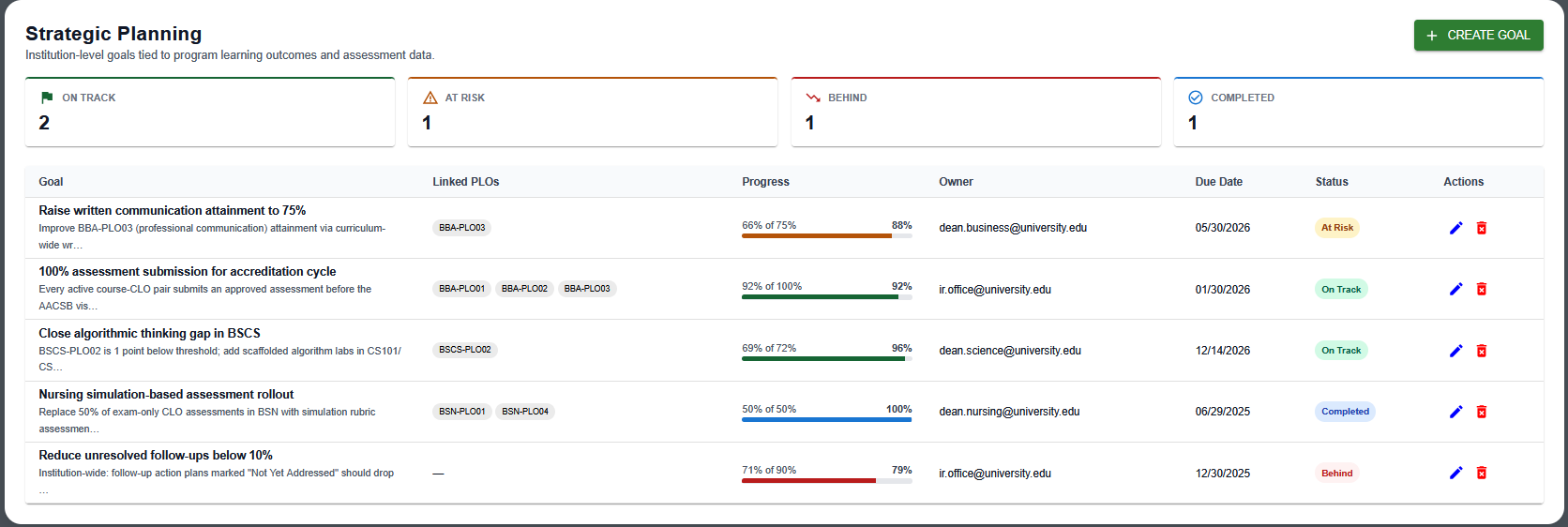
Connect institutional goals to program outcomes and assessment evidence so improvement priorities remain measurable, owned, and visible.
Shared data definitions, templates, workflows, and institutional expectations.
Clear responsibilities for faculty, coordinators, administrators, and executives.
Evidence remains visible from course-level assessment through mission fulfillment.
Institutional leaders can identify priorities, risk, progress, and opportunities for improvement.
Alignify does not replace institutional judgment.
Less fragmentation across assessment and planning
Greater consistency without sacrificing academic judgment
Clearer evidence for accreditation and institutional reporting
Stronger executive visibility into institutional performance
Every successful transformation begins with a shared direction. Alignify helps institutions move from disconnected assessment activities to coordinated institutional capability through a structured, collaborative journey.
We begin by understanding your institution's assessment practices, governance structure, accreditation priorities, and strategic goals.
Establish a shared methodology that connects faculty work, meaningful evidence, governance, and institutional priorities.
Deploy the Alignify Platform to create one connected institutional operating system supporting every level of the organization.
Use meaningful evidence, executive insight, and continuous improvement to strengthen institutional performance and demonstrate mission fulfillment.
Assessment Is the Starting Point.
Where meaningful evidence becomes executive insight, coordinated action, and mission fulfillment.